A randomised controlled trial from Beijing’s Guang’anmen Hospital found a traditional herbal formula significantly outperformed placebo for Fibromyalgia pain, sleep quality and overall disease impact over 12 weeks.
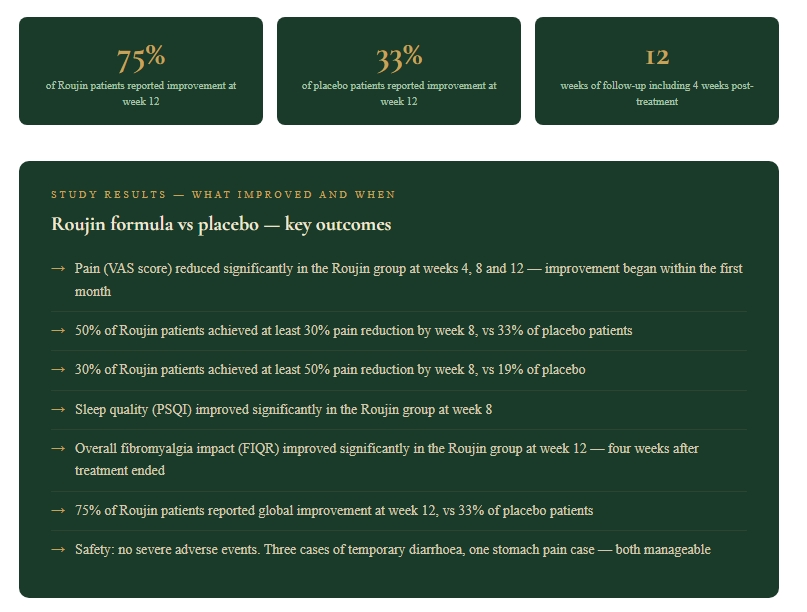
Fibromyalgia is one of the most challenging conditions in modern medicine. Widespread pain, unrefreshing sleep, fatigue, brain fog — and conventional treatment that too often offers only partial relief. A new randomised controlled trial from one of China’s leading research hospitals offers something more encouraging: a specific herbal formula that significantly reduced pain and improved sleep compared to placebo, with effects that lasted beyond the end of treatment.
What the researchers did
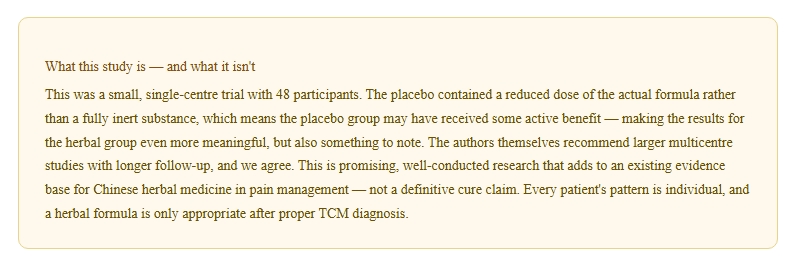
The trial was conducted at the Rheumatology Department of Guang’anmen Hospital — part of the China Academy of Chinese Medical Sciences in Beijing, one of the most respected TCM research institutions in the world. It enrolled 48 patients who met both the 1990 American College of Rheumatology diagnostic criteria for Fibromyalgia and the TCM pattern of liver depression and spleen deficiency.
Participants were divided equally into two groups: 24 received the Roujin herbal formula twice daily for 8 weeks, and 24 received a placebo. The study followed patients for a further 4 weeks after treatment ended — a total of 12 weeks — to see whether any benefits persisted after stopping the formula.
The formula — seven herbs, one TCM principle
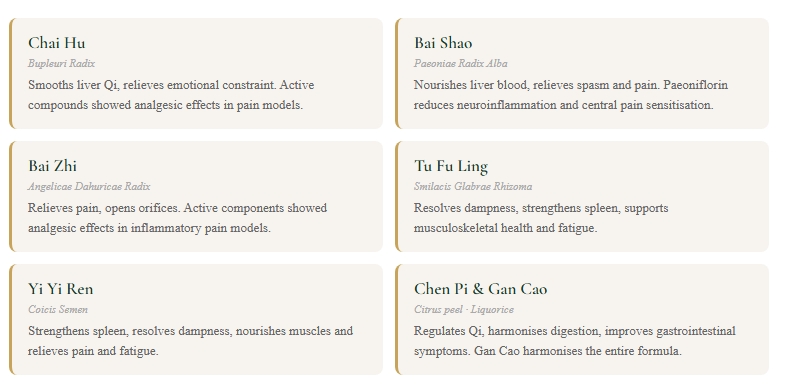
The Roujin formula is derived from Xiaoyao San — one of the most historically significant formulas in Chinese medicine, used for centuries to address the combination of emotional constraint, liver imbalance and digestive weakness. In TCM terms, Fibromyalgia presenting with widespread pain, fatigue, poor sleep and emotional distress is a classic liver depression and spleen deficiency pattern. The Roujin formula is specifically constructed to address exactly this.
Why the herbs may work — the science behind the formula
The research team looked closely at the pharmacology of the individual herbs, and the findings are striking. The key active compound in Bai Shao — paeoniflorin — reduces neuropathic pain by inhibiting a stress-activated kinase (ASK1) involved in inflammatory signalling and nerve damage. It also increases expression of Sirt1, a regulatory protein that reduces neuroinflammation in the spinal dorsal horn — the part of the spinal cord where pain signals are processed. This may in turn influence BDNF, a key driver of central sensitisation — the process by which the Fibromyalgia brain becomes hypersensitive to pain signals.
In plain terms: the herbs in this formula don’t simply mask pain. They appear to work at the level of the nervous system’s pain-processing pathways — reducing the neuroinflammation and sensitisation that makes Fibromyalgia pain so persistent and so difficult to treat.
The TCM perspective on Fibromyalgia
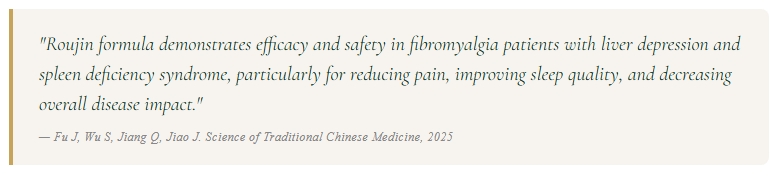
What makes this study particularly relevant to clinical practice is the TCM diagnostic criterion used for patient selection — liver depression and spleen deficiency. This is not an abstract category. It describes something very specific and very recognisable: a person whose pain is made worse by stress, who feels frustrated and stuck, whose digestion is often sluggish, who wakes unrested despite sleeping, and who struggles to find the energy to do things they want to do.
This pattern is what we see repeatedly in Fibromyalgia patients who come to AcuRodos. The formula studied here — Xiaoyao San and its derivatives — is one of the most established formulas in our clinical toolkit for exactly this pattern. Acupuncture at points like LV3, SP6, ST36 and GB34 works synergistically with herbal medicine to address both the root and the manifestations of this pattern simultaneously.
What this means if you have Fibromyalgia
If you have been diagnosed with Fibromyalgia and conventional treatment has not given you sufficient relief, Chinese herbal medicine and acupuncture together offer a genuinely different approach — not by blocking symptoms, but by addressing the underlying pattern of imbalance that drives them. At AcuRodos, Jose holds a BSc in Food Science and extensive clinical training in TCM — making him particularly well placed to combine herbal medicine guidance with acupuncture in an integrated treatment plan.
A herbal consultation at AcuRodos involves full TCM assessment of your specific pattern — tongue, pulse, symptoms, history — before any preparation is discussed. Any preparation suggested would be based entirely on your individual presentation, not a standard formula applied to a diagnosis.
Source: Fu J, Wu S, Jiang Q, Jiao J. Therapeutic efficacy of Roujin formula in managing Fibromyalgia patients with liver depression and spleen deficiency syndrome: A single-blinded randomized controlled trial. Science of Traditional Chinese Medicine 3, no. 1 (2025): 62–68. Reported by HealthCMi, April 2026. This blog post is for informational purposes only and does not constitute medical advice. Herbal preparations at AcuRodos are discussed and supplied following individual personal assessment only.